Service Design
Laurier Wellness Services
Wilfrid Laurier's Wellness Services do good work, but a lot of students never make it through the door. This project asked why, using real research instead of assumptions.
Role
UX Researcher & Service Designer
Team
Nithin, Cam, Kris, Brayden, Hannan, Nitin
Course
UX 112
Tools
Service blueprints, secondary research, Figma, Canva
The Challenge
65% of Laurier students didn't know what wellness services existed, and the ones who did had to navigate six separate departments on their own.
My Approach
Analysed a research report covering 450+ student surveys, 28 interviews, and 16 staff interviews, then mapped the full service blueprint and benchmarked four peer universities.
The Result
A complete service blueprint plus two resourced proposals targeting the awareness gap, delivered as a final report and presentation.
My Contribution
Team of 6 in UX 112. I worked on the research synthesis, the service blueprint mapping, and the two service propositions.
The Challenge
Laurier's wellness services operate in departmental silos. The Student Wellness Centre, Accessible Learning Centre, Dean of Students Office, Athletics & Recreation, and residence life programming all run largely independently. Students have to navigate between them on their own, often repeating their story and filling out redundant intake forms. The whole system is also built to respond to crises rather than prevent them, which means it strains hardest exactly when demand peaks.
Who's Affected
- Undergraduate and graduate students, domestic and international
- Faculty and staff who interact with students in distress
- Wellness service providers dealing with overwhelming demand
- Academic departments managing accommodations and extensions
When It Hits Hardest
- Beginning and end of semesters (September, December, April)
- Midterm examination periods
- Transition periods like first year and graduation
- Winter months, tied to seasonal affective disorder
Context that shaped the whole project: a 2021 survey from the Canadian Alliance of Student Associations found 68% of post-secondary students felt overwhelming anxiety, and 51% felt so depressed it was difficult to function. This wasn't a niche problem to design around. It was the baseline.
Research
We analyzed a comprehensive wellness research report from Unless Design covering surveys, interviews, and usage data, and mapped the findings against four phases of the student journey.
Awareness & Discovery
- 65% of students didn't know what services were even available
- 72% were confused about which service was appropriate for them
- 48% cited stigma as a real barrier to reaching out
Navigation & Access
- 68% found the booking process too complex
- Average wait times of 2–3 weeks for non-urgent appointments
- Students filled out an average of 3.4 redundant intake forms
Service Engagement
- Average satisfaction rating: 3.2 out of 5
- 58% of international students felt culturally unsupported
- 22% no-show rate, largely due to follow-up complexity
Continued Care
- Fragmented follow-up procedures between departments
- 76% cited financial barriers to off-campus referrals
- Very limited long-term support options once a case closed
Service Blueprint
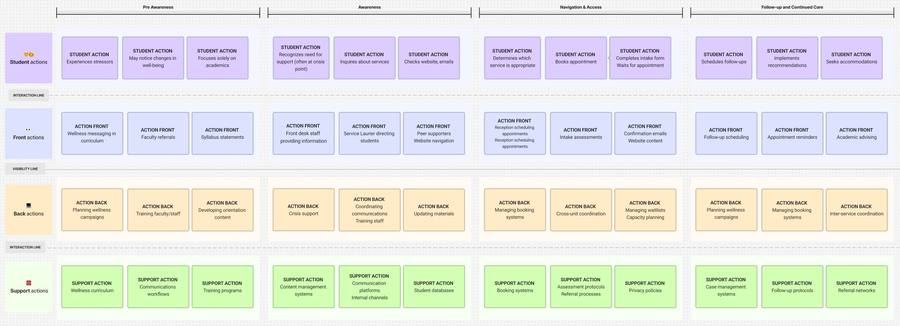
Mapping the frontstage, backstage, and support layers of the service exposed where things actually break down, and not just where students feel friction but why.
Frontstage Problems
- Fragmented student touchpoints spread across departments
- Inconsistent messaging about what services even exist
- Limited visibility into wait times before committing to book
Backstage Problems
- Siloed record-keeping systems that block information sharing
- Duplicated administrative processes across departments
- Limited capacity for prevention work because crisis demand eats the budget
What Other Universities Do
Part of the research looked at how peer institutions had already solved pieces of this problem.
Queen's & McMaster
- Queen's stepped-care model reduced wait times by 43% and increased capacity by 28%
- McMaster's "no wrong door" intake, under one administrative umbrella, got 76% of students reporting higher satisfaction with navigation
Calgary & UBC
- Calgary's "Community of Caring" early-intervention framework cut crisis incidents by 17%
- UBC's approach embeds wellbeing directly into academic policy instead of treating it as purely clinical
Service Proposition
The Awareness & Discovery phase turned out to be the highest-leverage place to intervene. Fixing it could keep an estimated 40% of students from falling through the cracks in every phase that follows. We proposed two service changes there.
1. Preventative Wellness Framework
- A three-tiered model: 40% of resources to primary prevention (education, community-building, curriculum integration) before problems develop
- 35% to secondary prevention, covering early identification and peer support for at-risk students
- 25% to tertiary prevention, meaning clinical services for students already in crisis
2. Academic Integration Strategy
- A faculty wellness champion embedded in each academic department
- Wellness-infused curriculum design guidelines and policy review
- "Wellness moments" built into large courses during high-stress periods
What the research told me
The findings that decided where to intervene.
Insight 01
Awareness is the leak
65% of students didn't know what services existed. Fix this phase and an estimated 40% of students stop falling through later gaps.
Insight 02
The system is built for departments, not students
Siloed records, duplicated intake, and inconsistent triage all trace to the same root: optimized for departmental efficiency.
Insight 03
Others have already solved pieces of this
Queen's, McMaster, Calgary, and UBC each proved a different piece of the fix works in practice.
How people move through it
Mapped as a service ecology across four phases, then as a six-phase service blueprint.
Service Ecology Phases
- Awareness and Orientation: website, orientation booths, social media, campus posters, course syllabi
- Onboarding: Wellness Centre front desk, online booking, intake questionnaires, Service Laurier counter
- Usage: counselling offices, workshops, referral forms, progress trackers, self-help materials
- Support: follow-up appointments, self-monitoring apps, feedback surveys, community services
Service Blueprint Phases
- Awareness Research Booking & Consultation Getting the Help Following Up Feedback
- Each phase mapped across student actions, frontstage staff, backstage operations, and supporting systems
- The most critical weaknesses appear at the boundaries between phases, where handoffs break down
Exploring the options
Two propositions chosen from a wider set of approaches the research surfaced.
Approaches Considered
- Stepped care models that allocate resources by need intensity
- Integration of wellness services under unified administration
- Embedding wellness into non-clinical university environments
- Digital platforms to streamline service navigation
Why These Two
- The Preventative Wellness Framework targets the 65% awareness gap directly, with a resource split modelled on what other universities actually funded
- The Academic Integration Strategy reaches students where they already are, in courses, instead of waiting for them to seek out a service
Designing for everyone
Inclusion was a research finding here, not just a design constraint.
What The Research Showed
- 58% of international students felt culturally unsupported, so cultural responsiveness became a named gap in the proposition
- Students in crisis often lack the energy or clarity to navigate complex systems, which is why a single clear entry point matters
- Stigma was cited by 48%, so normalizing help-seeking within academic contexts became an explicit goal
What came out of it
A complete service blueprint and two concrete, resourced proposals delivered as a final report and presentation, grounded in real survey data and benchmarked against four peer universities rather than intuition about what students probably need.
What I learned
Financial literacy and mental health both share a strange problem: people don't want to admit where they're struggling, especially in a survey. Comparing our findings against what Queen's, McMaster, Calgary, and UBC had already tried made me look for a plausible mechanism, not just a promising statistic. That's what kept the Preventative Wellness Framework's resource split honest instead of arbitrary. It's modeled on what those other schools actually funded to get their results.